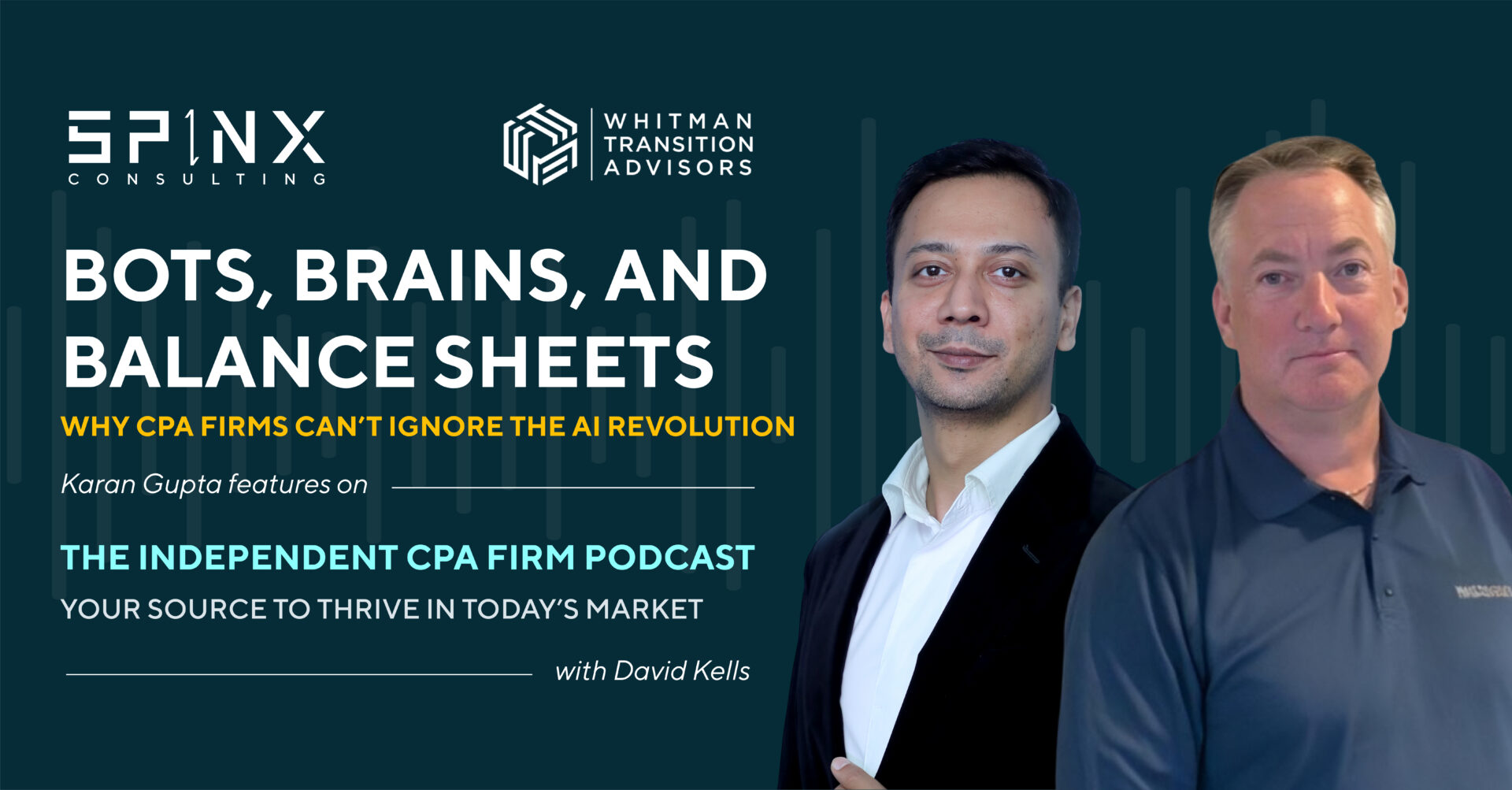
Insights from Karan Gupta, Chief Vision Architect at SPNX Consulting, based on a recent conversation on The Independent CPA Firm Podcast with David E. Kells
When Karan Gupta sat down with David E. Kells on The Independent CPA Firm Podcast, the conversation was supposed to be about outsourcing. It became something broader: a candid look at why the accounting profession is at a turning point, and what independent CPA firms need to do about it before the window closes.
What follows draws on that conversation and on a decade of building offshore capability centers for accounting firms, first in the traditional model and now in what we call Outsourcing 4.0. The perspective is shaped by real projects, real failures, and the patterns that keep showing up across firms of every size.
The Profession Most Exposed to AI
There’s a way to frame this that tends to get uncomfortable silence in a room full of accountants, but it’s worth saying plainly: accounting is one of the professions most susceptible to AI disruption.
Think about what the work actually involves on a daily basis. Data gets extracted from bank statements, ledgers, and various systems. That data gets processed, mostly in Excel. Then it gets turned into a report, a return, or a set of financials. That workflow, extract, process, present, is precisely what large AI models are built to do.
This isn’t a future scenario. It’s happening now. And yet, having spoken at events in ten countries over the past three years, the reaction is almost always the same: polite disagreement, followed by a quick change of subject. Not because people don’t see it coming, but because the implications are uncomfortable enough that it’s easier to look away.
The profession has been slow to adopt technology for years. We’ve been data analysts our entire careers and most of us still haven’t learned SQL, Python, or even Power BI. We do everything in Excel and call it good enough. That gap between what’s possible and what’s practiced is about to matter a lot more.
Margin Compression Is Speeding Up
Every professional service follows a predictable arc. A new offering starts with high fees and healthy margins. Competition enters. Fees hold for a while but margins shrink. Eventually both drop, and the service either gets commoditized or replaced. That cycle used to take ten years or more. Tax advisory enjoyed a long stretch of premium pricing before it became a volume game. Consulting practices followed a similar path.
With AI in the picture, that entire cycle is compressing into about twelve months.
A service that commands strong margins today can be replicated by an AI-augmented competitor within a year, delivered faster, at lower cost, and often at comparable quality. Firms that aren’t building AI into their delivery model aren’t just missing an efficiency gain. They’re watching their pricing power erode in real time and most won’t notice until the revenue starts to follow.
AI Is Not Magic. That’s Actually the Point.
One of the most dangerous ideas floating around the profession right now is the belief that AI is all or nothing. Either it’s a magic box that replaces entire workflows overnight, or it’s hype that can be safely ignored. Both takes lead to the same place: inaction.
There’s a story from SPNX’s early AI work that illustrates this well. A large client wanted to automate roughly 80% of their valuation practice. The team agreed, committed three months to it, and the whole thing failed. Not because the technology fell short, but because the approach was wrong. They tried to automate an entire practice in a single pass, without breaking it into discrete steps, and without meaningful involvement from the client’s own team.
That failure reshaped how every AI engagement gets structured now. The approach that works, and the one that has consistently delivered results since, looks like this:
- Break the work down. Every workflow gets decomposed into its smallest repeatable tasks: data extraction, data cleaning, validation, formatting, review. Each one gets treated as its own problem.
- Automate one thing at a time. Build a purpose-specific bot for a single task. Train it. Operationalize it. Get it right. Then move to the next.
- Connect as you go. Once individual automations are stable, they start getting linked into agentic workflows where bots hand off to bots, with humans reviewing only at the decision points.
- Plan in years, not weeks. Meaningful AI transformation takes months and years. Anyone promising otherwise is selling a fantasy.
It’s slower to start, no question. But it compounds. And over time, it builds a capability that becomes a real competitive advantage, not just a cost saving.
Outsourcing 4.0: What It Actually Means
The term “Outsourcing 4.0” gets used a lot at SPNX, and it’s worth explaining what it means in concrete terms, because it’s a fundamentally different model from what most firms picture when they hear “offshoring.”
In the traditional model (call it versions 1.0 through 3.0) the value proposition was simple: access talent at a lower cost. The delivery unit was people. The metric was headcount. The risk was quality.
The 4.0 model inverts that. The delivery unit becomes a managed process, supported by AI and overseen by subject matter experts. The metric isn’t how many people you have offshore. It’s how few you need. The whole point is to reduce dependency on headcount itself, not just what it costs.
This is where timing matters in a way that most firms haven’t fully grasped. If you’re building a center of excellence today, in 2026, you don’t need to replicate the human-heavy infrastructure that legacy outsourcers spent years putting together. You can build AI-native from day one, embedding automation into every process from the start instead of trying to bolt it on later.
For small and mid-sized firms, this is a real structural advantage. And for those who feel they’re too small to go it alone, pooling resources with a few other firms to create a shared center of excellence is a path that’s increasingly practical.
The Due Diligence Problem
Even when the strategic case is clear, the execution often breaks down at the very first step: choosing a partner.
The most common failure pattern among smaller firms is inadequate due diligence. Firms either chase the lowest possible rate (five or six dollars an hour, with no compliance infrastructure behind it) or they find a credible provider, get nervous about the investment, and stall indefinitely. Neither approach gets them anywhere.
What works is a structured evaluation against a short list of non-negotiables: SOC 2 Type II compliance, an onshore US presence with experienced practitioners, subject matter expertise in the relevant service lines, and most importantly, a documented process maturity framework that gets applied before any work is delivered offshore.
That last point is worth emphasizing. Without process discipline, outsourcing fails. It doesn’t matter how talented the offshore team is. If the work gets plugged into an immature, undocumented process, the results will be inconsistent, and the firm will blame the vendor when the real problem was never addressed.
Three Paths Forward
There’s no way to sugarcoat the choice facing independent CPA firm leaders. As things stand, there are essentially three paths:
- Evolve. Invest in AI, build or join a center of excellence, develop a genuine differentiator. This takes capital, commitment, and a willingness to plan in years rather than quarters. But it’s the path that preserves independence and positions a firm for long-term relevance.
- Merge or take outside investment. Private equity is entering the accounting space at scale. For firms that don’t have the resources or appetite to transform on their own, a strategic partnership or acquisition may be the most rational way to stay viable.
- Stay the course and hope for the best. This is the default for firms that neither invest nor consolidate. The margin compression cycle will run its course, and within a few years the competitive position becomes very difficult to recover.
What makes this moment different from previous inflection points is the speed. The profession has always been slow to change. The technology driving the change is not.
Final Thoughts
Mustafa Suleiman gave a TED talk in which he described artificial intelligence as a new digital species. Not a tool. Not a platform. A species.
That’s a big idea to sit with. But it captures something important about the scale of what’s happening. We aren’t deciding whether to adopt a new piece of software. We’re figuring out how our profession relates to a fundamentally new kind of intelligence, one that can already perform a large share of the work we’ve been doing for decades.
The firms that take this seriously will be the ones still standing five years from now. The ones that don’t will look back and wonder what happened.
Listen to the full episode here